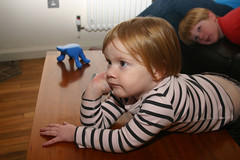
Like many Scots P appears to be part salmon and come Christmas she is overtaken by a instinctual imperative to struggle back to her spawning ground. In consequence the Moobses tend to meet a couple of weeks before the big day and have an ersatz yuletide. This year my sister C came over from Holland with her kids. When I opened the front door C’s little son Sam came spinning in to the house full of excitement. Behind him was, to my amazement, my sister C but as she had once been: an auburn-haired three year old bright-eyed and purposeful. It was as if someone had torn time apart and she had stepped from her childhood into my middle age. It was Emma, C’s daughter. Emma stepped forward and gave my leg a hug.
C was 40 last week. Her life has been neither straightforward nor easy. As a child she was fearless. When, at age 6, I clung to Mum’s flared trouser leg and refused to go and spend a weekend with my grandparents, C simply climbed into the back of their car and waited for them to get under way.There has always been something of a psychological division between the boys and the girls in my family. My brother and I are blatherers and, at heart, a little fearful. Sometimes the fear works for us. Faced with examinations we get scared and get working. C, who is almost certainly the brightest of the four of us, did less well academically. This was partly born of the blows to self-confidence that my father was so adept at delivering and partly because she didn’t fear the consequences of doing badly. C is, at heart, a tender soul and is easily wounded but she responds to each affront with fire and defiance. What she has in common with all the Moobs kids is that she is an expert in everything and will not let the actual experience of others get in the way of her lecturing them about their own area of expertise. The four of us probably account for about 80% of the world’s remaining reserves of lightly-informed but loudly-declared opinions (17% being stored in London cab drivers).
When she was old enough for high school, C went off to a convent boarding school. Had I been sent to boarding school I would have wet myself nightly and ending up choking to death on self-pitying poems about abandonment. C appeared to thrive. There came a time when my Father felt that the results being achieved were not matching the outlay on fees and poor C was taken from the school and dumped into a pitifully inadequate pseudo-school run in a house in our local town. The candy-striped dresses and straw boaters that the schoolgirls were made to wear demonstrated that even in the context of a town inclined to see a walkman as the hand-tooled instrument of the devil and rush, pitchfork in hand, to fend off modernity, the school was a laughable anachronism. The purpose of the school seemed to be to turn out women with enough education to equip them to entertain when throwing dinner-parties for their executive husbands. It should not have been surprising, therefore, when C announced, well short of her eighteenth birthday, that she was getting married.The lucky man was doughy polyp called Ian. He was barely older than C and was starting out as a car mechanic. In a nod to tradition he called upon my father and asked for permission to marry. I vivdly remember Ian trudging into our sitting room, where my Father lay waiting for him. It was all handled with considerable formality, the opening question being, improbably, “Do you play golf?” Ian did not play golf. I doubt that much affected the outcome but he was told no. C, characteristically, told us she was getting married anyway and moved out, taking up a job in a residential care home. There was an engagement party and she acquired a ring from Ian but had a change of heart and moved instead to London. London was so remote and so different a place, we could not have been more surprised if she had jumped up and started floating towards the moon. Again, she was utterly fearless and set about a career as a nanny.
I was still at university when she announced that she was pregnant. The father was a man called Alan who was from Hull or Hartlepool. He proved to be utterly feckless and fecked back off north instantly. This did nothing to deflect C from her march to motherhood. I don’t recall her expressing so much as a doubt let alone regret about the turn her life had taken. Whilst I was only then taking my first wobbly steps into the world of adult relationships, C seemed to have grown up fast enough to shoot past me and over the horizon. I did not feel like her older brother. C gave birth to Charlotte, her first daughter, far too early and she was stillborn. Charlotte’s scintilla of a life produced a single polaroid and a hole in our hearts.
C picked herself up and resumed her nannying. She was comforted by a man named Mark with whom she moved in. Mark too was something of a pudding. He was capable of sitting inert watching television with such focus that even C’s increasingly strident scolding did nothing to rouse him into trying to make something of their lives together. At one point, to our amazement, he stood up from the armchair and went on a hiking holiday abroad with some friends. C slipped a tape cassette into his rucksack full of songs, alternately angry and doleful, complaining of abandonment. Heaven only knows what went through his mind when he turned on his walkman and heard “Love Don’t Live Here Anymore”.
C is now married to another Ian. That is a story for another time. She has grown into an excellent mother: She is tender and patient with her children and they are thriving. Seeing her hold Emma’s tiny hand as they walked together to the garden gate made life somehow ring like a guitar harmonic.
C has some strange ways. In particular, in recollection she rewrites the past as a melodramatic soap opera. I was, for instance, surprised to learn that I had, apparently, spent my time at university yearning with unrequited love for Princess Charlotte of Luxembourg. Dodgy though her memory may be, I adore her. I gave a speech at her wedding and said something that will always be true: They say you can choose your friends but you cannot choose your family, but if I could choose my own sister I would choose C.
Average Rating: 4.7 out of 5 based on 209 user reviews.